Are VPNs Legal? A Global Guide to VPN Legality
Governments treat VPN users differently. In the so-to-speak free world, the government doesn’t care what you do online as long as you don’t look up…

Protect your online privacy and security
Fast, private, and easy to use, get Hidzo on your device and browse freely with one tap.
Get HidzoVPNTable of Contents
Governments treat VPN users differently. In the so-to-speak free world, the government doesn’t care what you do online as long as you don’t look up “how to explode a building.” Well, if you use a VPN, they won’t be able to see that, and they consider it a misuse of VPN, and you’ll get in trouble.
So, the answer is yes. VPNs are legal unless used for evil. But there are countries where using a VPN has serious consequences, regardless of why you use it. Stay with us to get around the world and check VPN legality worldwide.
The Big Picture: VPN Legality Worldwide
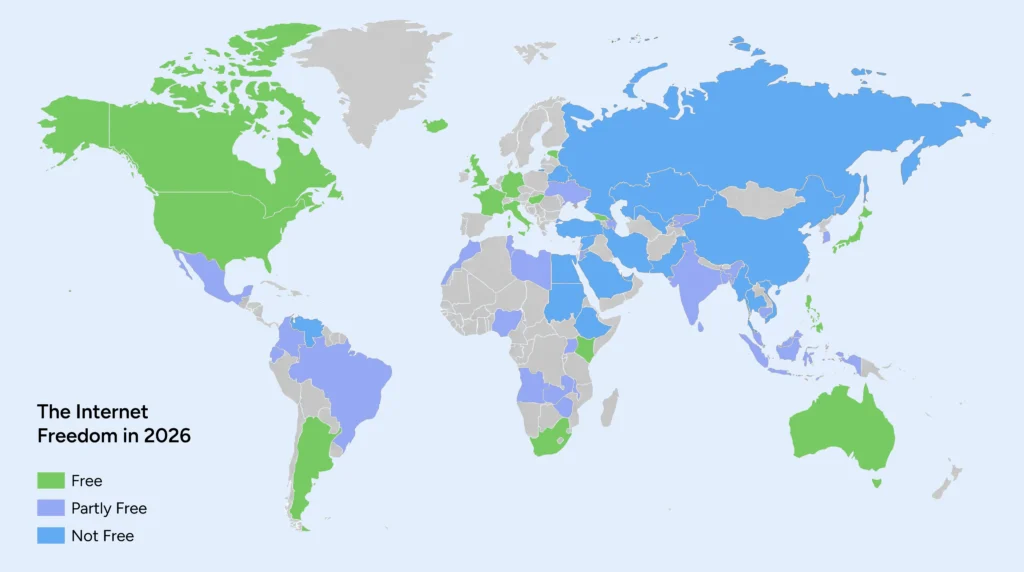
Here’s the reassuring headline you’ve been waiting for: VPNs are legal in over 90% of countries in 2026. Whether you’re sipping coffee in Berlin, working remotely from Bali, or browsing from a laptop in Buenos Aires, using a VPN is generally as lawful as using a password manager or wearing sunglasses in public.
Governments mostly allow (and sometimes even quietly encourage) them because businesses rely on secure connections, travelers need protection on dodgy hotel Wi-Fi, and privacy-conscious folks treat them like digital seatbelts. In short, a well-behaved VPN is usually just another everyday cybersecurity tool.
That said, the internet isn’t one big happy village, and a few spots on the map play by very different rules. Here’s a friendly breakdown of the main categories:
1. Fully Legal & Unrestricted (The Comfort Zone)
This is where most people live. You can connect to a VPN, switch servers, and stream your favorite shows without worrying about the authorities knocking on your (virtual) door. Countries like:
🇺🇸 The United States
🇨🇦 Canada
🇬🇧 The United Kingdom
🇪🇺 EU nations
🇯🇵 Japan
🇰🇷 South Korea
🇧🇷 Brazil
🇲🇽 Mexico
🇿🇦 South Africa
And the majority of Latin America and Southeast Asia have no laws against using VPNs.
2. Legal with Some Caveats (The “Yes, But…” Zone)
Here, VPNs are allowed, but governments keep a closer eye on things. Think mandatory data retention for providers, or rules that kick in if you use them for illegal activities (which, spoiler alert, remains illegal no matter what tool you use).
🇮🇳 India: VPNs are fully legal for users, but providers must maintain detailed logs (user data, IPs, timestamps) for 5 years under CERT-In rules. Many major VPNs have withdrawn physical servers from India to avoid compliance.
🇦🇺 Australia: Legal, but the country has mandatory data retention laws that apply to telecommunications providers (and can indirectly affect VPNs). There are also ongoing debates around age verification and anti-circumvention measures.
🇹🇷 Turkey: Legal on paper, but the government frequently blocks popular VPN providers and services, especially during periods of political tension. Heavy filtering and selective enforcement are common.
🇵🇰 Pakistan: Legal but increasingly regulated; providers may need licensing, and there have been blocking campaigns.
🇦🇪 United Arab Emirates (UAE): VPNs are allowed for businesses and some personal use, but only approved services. Heavy fines (tens to hundreds of thousands of dollars) apply for using them to access blocked VoIP or other restricted content.
🇪🇬 Egypt and some other Middle Eastern/North African countries: Legal with surveillance and potential logging expectations.
3. VPN Restricted Countries (The Gray Area)
These countries take a “you can use a VPN… but only the ones we like” approach. Remember, even in these places, simply having VPN software installed isn’t always the main issue. It’s using it to bypass controls or access prohibited content that usually triggers problems.
🇨🇳 China: Only government-approved VPNs are fully legal. The Great Firewall uses advanced detection (more on that in the technical section) to block most foreign services. Tourists sometimes get away with it quietly, but residents and long-term visitors play a constant game of hide-and-seek.
🇷🇺 Russia: Providers must register and help block banned sites. Many popular VPNs get blocked, and using them to access “extremist” content can bring fines. Enforcement comes in waves.
🇮🇷 Iran, 🇴🇲Oman, 🇺🇬 Uganda: Heavy restrictions, with approved services often logging activity.
Quick Risk Summary Table
| Risk Level | Examples | Typical Consequences | Vibe Check |
|---|---|---|---|
| Extreme | North Korea | Severe (potentially life-changing) | Don’t even think about it |
| High | Turkmenistan, Iraq, Belarus | Fines to years in prison | Strong avoidance advised |
| Medium-High | China, Iran | Fines, blocks, possible jail | Cat-and-mouse game |
| Medium | Russia, UAE, Turkey | Blocks, fines, selective enforcement | Proceed with eyes open |
VPN Tips for Traveling to Gray Areas
- Traveling through risky countries: Many governments focus more on locals than short-term tourists. Still, the smartest move is to avoid using a VPN (or limit it heavily) while physically inside the country. Connect before you arrive or after you leave.
- Corporate vs. personal use: Some places are stricter with individuals but more lenient with businesses using approved solutions.
- Enforcement reality: In most restricted countries, authorities go after big fish (activists, journalists, large-scale users) more than the average person trying to check email. But “low risk” isn’t “zero risk.”
4. Outright Illegal or Heavily Criminalized (The No-Go Zones)
A small handful of countries ban VPNs (or all strong encryption tools) for ordinary citizens. In these places, a VPN isn’t just frowned upon; it can be treated like smuggling forbidden knowledge.
🇰🇵 North Korea: The ultimate no-go zone. Ordinary citizens barely have internet access, and using a VPN (or pretty much any unauthorized connection) can bring shockingly severe penalties; we’re talking levels that make other countries look lenient.
🇹🇲 Turkmenistan: One of the strictest enforcers. Unapproved encryption tools (including most VPNs) can land you up to 7 years in prison. The government really doesn’t like digital detours.
🇧🇾 Belarus: VPNs and other anonymizing tools have been restricted or banned since 2015, with stronger enforcement during political tensions. It’s treated as part of broader efforts to control online activity.
🇮🇶 Iraq: Blanket ban since 2014. No exceptions for regular folks. Using one can lead to fines or legal trouble.
The Golden Rule of VPN Legality:
Using a VPN doesn’t make illegal activities legal. Piracy, fraud, or accessing genuinely prohibited content can still land you in hot water; the VPN just makes your connection more private, not invisible or invincible.
When Can VPN Use Become Illegal?
When you’re doing something illegal. Law enforcement can still request data from your ISP, websites you visit, or even the VPN provider (if they keep any logs or payment records). Using a VPN makes you harder to track, not invisible.
Using a VPN doesn’t make illegal activities legal. Piracy, fraud, or accessing genuinely prohibited content can still land you in hot water; the VPN just makes your connection more private, not invisible or invincible.
Emerging Scenarios on VPN Legality
One fascinating development: Age-verification laws. In May 2026, Utah became the first U.S. state to explicitly target VPN use for bypassing age gates on adult content sites. The law holds that if you’re physically in Utah, websites must treat you as a local user even if you’re using a VPN to appear elsewhere. Similar discussions are bubbling up in Europe and elsewhere.
It’s a perfect example of the tension: governments want to protect minors, but heavy-handed rules risk turning everyday privacy tools into collateral damage. As one witty observer might say, it’s like banning umbrellas because some people use them to hide from the rain… while it’s still raining.
How Governments Detect and Block VPNs
Governments and ISPs don’t just wave a magic wand to block VPNs; they use clever (and sometimes impressively persistent) technical tricks.
1. Deep Packet Inspection (DPI)
Deep Packet Inspection is the star of the show. Unlike basic firewalls that only check the envelope (IP addresses and ports), DPI opens the packet and examines the actual contents and patterns, even if the payload itself is encrypted.
Regular packet inspection is like glancing at a car’s license plate. DPI is like popping the hood, checking the engine sound, and running a background check on the driver.
- It looks for protocol signatures: Specific handshake patterns in OpenVPN, WireGuard’s noise protocol quirks, IKEv2 traits, etc.
- It analyzes traffic metadata: Packet sizes, timing, entropy (randomness), and flow behavior. VPN traffic often has more consistent packet sizes or burst patterns than normal browsing.
- Modern versions (especially in China’s Great Firewall) use machine learning to spot “VPN-like” behavior with scary accuracy, even for obfuscated traffic.
2. The Virtual Hammer: IP Blocking & Port Blocking
- IP blacklisting: Governments maintain (and constantly update) lists of known VPN server IPs, especially datacenter ones. If your traffic heads to one, it gets dropped.
- Port blocking: Common VPN ports (e.g., 1194 for OpenVPN, 500/4500 for IKEv2) get restricted. Some blocks are smarter and target dynamic ports too.
This is why good providers rotate IPs frequently and offer residential or mobile-like exit nodes.
3. SNI Filtering & TLS Fingerprinting
When using TLS-based connections (common in stealth modes), the Server Name Indication (SNI) in the TLS handshake reveals the destination domain. Censors can block or throttle based on that.
Advanced systems also fingerprint the TLS Client Hello (JA3 fingerprints) to spot non-standard VPN implementations.
4. Active Probing
This is particularly sophisticated (hello, Great Firewall and similar systems in Russia/Iran).
After detecting suspicious outbound traffic:
- The censor’s system itself connects to the suspected server.
- If the server behaves like a VPN (specific response, open ports, handshake), the IP gets instantly blacklisted.
It’s like the bouncer not only watching you enter the club but also calling the club later to confirm you’re bad news.
The VPN’s Counter-Moves
This is where the arms race gets fun. Modern “stealth” or obfuscated servers fight back by:
- Protocol wrapping: Making VPN traffic look like regular HTTPS (port 443) traffic.
- Packet scrambling / XOR obfuscation: Randomizing headers and patterns so DPI can’t recognize the signature.
- Traffic morphing: Adjusting packet sizes, timing, and flows to mimic normal web browsing or video streaming.
- Shadowsocks, Reality, or custom pluggable transports: Advanced methods that blend in even better.
Why Do People Use a VPN?
VPNs have different use cases, but at the core, people use them because of the security and encryption that keep them safe and private online. These use cases can be personal or professional (corporate use cases).
Continue reading: Why You Need a VPN in 2026 (Even for Daily Browsing)
Practical Guidance for Using a VPN
We’re becoming more and more predictable because we’re leaving online security to the internet itself. Without a VPN, our traffic is visible to ISPs and trackers, and they know us better than our best friend. To reclaim our privacy, we need VPNs, and here’s how to choose and use one.
Smart Questions to Ask Before Using Any VPN
Instead of chasing shiny marketing claims, focus on these practical checkpoints:
- Does it have an independent security audit? (Recent ones from reputable firms are gold.)
- Is there a proven kill switch and leak protection? (This stops your traffic if the connection drops.)
- What protocols does it support? (Modern ones like WireGuard are fast and efficient; older ones may be more compatible but slower.)
- Where is the company based, and what are the local data retention laws?
- Do they publish transparency reports and have a clear no-logs policy backed by audits?
Everyday Best Practices
- Always use the kill switch and enable leak protection (DNS, WebRTC, IPv6). These are your silent guardians.
- Prefer obfuscated/stealth modes when in restrictive networks or countries.
- Use multi-hop connections when you want extra layers (slower but more private, like taking two trains instead of one direct bus).
- Keep your software updated. VPN protocols and detection methods evolve quickly.
- On public Wi-Fi? VPN on. On your home network? Still worth it if you value privacy from your ISP.
- Combine tools wisely: A VPN + good browser hygiene (no unnecessary logins, privacy-focused browser) beats any single tool.
We’ve covered more of these privacy tips in a different post. Click to learn more.
Online Privacy Guide for Managing Your Digital Footprint: 5 Tools + 20 Tips
Ethical, Philosophical, and Broader Context
Let’s zoom out and ask the bigger, slightly uncomfortable questions that curious minds and tech professionals love to chew on: Should we even be using VPNs? Is privacy a right or a luxury? And where does the line sit between sensible self-defense and paranoid digital armor?
Privacy: Human Right or National Security Speed Bump?
Most democratic countries treat privacy as a fundamental right. Documents like the EU’s GDPR or various constitutions frame it as essential for freedom of expression and personal autonomy. A VPN, in this view, is simply a tool for reclaiming a bit of that autonomy in an era when your ISP can see (and sometimes sell) almost everything you do.
On the flip side, governments argue that strong encryption and easy anonymity can shield bad actors like terrorists, criminals, or people spreading harmful content. It’s the classic “If you’ve got nothing to hide, you’ve got nothing to fear” debate.
It’s like installing strong locks on your house. Most people see it as responsible. A few officials worry it makes it harder for the neighborhood watch to spot trouble. Both sides have a point, which is exactly why the conversation never gets boring.
The Real Heroes (and Everyday Users)
VPNs have quietly become lifelines for journalists in repressive environments, human rights activists, and people living under authoritarian regimes. They help dissidents communicate, researchers access blocked academic resources, and ordinary citizens in censored countries read independent news.
At the same time, in freer societies, millions use them daily for far less dramatic reasons: avoiding price discrimination while booking flights, protecting themselves on public Wi-Fi, or simply not wanting their every click turned into targeted ads. Neither use case is inherently more “noble.” They both reflect the same core desire: a little more control over your own digital life.
Corporate and Government Surveillance
Here’s the nuance that often gets skipped: surveillance isn’t just a “government vs. citizens” story anymore. Big tech companies, advertisers, and data brokers collect staggering amounts of information. VPNs don’t stop all of it (especially if you’re logged into services), but they raise the cost and reduce the ease of casual tracking.
The philosophical tension remains: How much surveillance should society accept in exchange for safety and convenience? There’s no universal answer. Different cultures and governments draw that line in very different places. What feels like reasonable protection in one country can feel like overreach in another.
A Balanced, Human Take
Using a VPN doesn’t make you a digital freedom fighter or a suspicious character. It usually just makes you someone who values privacy in an increasingly transparent world. The healthiest mindset is pragmatic: respect the laws where you are, don’t use tools to enable harm, and stay aware that no technology is a complete shield.
This broader perspective is what turns a simple “Are VPNs illegal?” question into something far more valuable. It helps us move from fear-based decisions to informed, thoughtful ones.
Conclusion + Key Takeaways
Are VPNs Legal? Yes! VPNs are legal in the vast majority of countries around the globe. In most places, using one is as normal and acceptable as using strong encryption on your email or locking your front door at night. However, a few countries play by very different rules, and even where they’re legal, a VPN is a powerful tool, not a magic “do whatever you want” button.
Key Takeaways
- VPNs are legal in ~90%+ of countries, but always check local laws, especially when traveling.
- VPN Legality ≠ safety, or anonymity. A VPN protects your connection but doesn’t make illegal activities legal or render you completely invisible.
- Technical sophistication matters: Understand DPI, obfuscation, kill switches, and audits if you want to use them effectively.
- In restrictive countries (China, Russia, UAE, Iran, etc.), the rules can be strict, and enforcement is clever. Proceed with caution and common sense.
- Privacy is a balancing act between individual rights and societal concerns. A VPN is considered digital hygiene, not paranoia.
FAQs
No, using a VPN is not illegal in the vast majority of countries. It only becomes illegal in a small number of countries with strict bans (e.g., North Korea, Turkmenistan, Iraq) or when using unapproved services in places like China and Iran.
Yes. VPNs are fully legal in the United States. Even federal agencies like the FBI have acknowledged their value for privacy and security. You won’t face legal trouble simply for using one.
Yes. VPNs are legal across almost all of Europe, including the EU, UK, Switzerland, and Norway. Some countries are introducing stricter age-verification rules, but using a VPN itself remains completely legal.
Yes, but only under specific circumstances. In countries where VPNs are restricted or banned (e.g., China with unapproved services, Iran, Turkmenistan, or Belarus), you can face fines, blocks, or even jail time.
Using a VPN for streaming geo-restricted content is legal in most countries, though it often violates the streaming service’s Terms of Service. Torrenting copyrighted material remains illegal in most places, regardless of whether you use a VPN.
In extreme cases like North Korea, Turkmenistan, Iraq, and Belarus, yes, installing or using unauthorized encryption tools can be treated as a serious offense. In China and Iran, only government-approved VPNs are typically legal for residents.
A genuine no-logs policy (especially one verified by independent audits) means the provider has little to hand over if subpoenaed.
Completely legal in most places and highly recommended. Public Wi-Fi is often unsecured, making it easy for others to snoop. A VPN encrypts your traffic, protecting you from man-in-the-middle attacks.
Yes, on their own networks. While it may be legal for you to use a VPN, private organizations can enforce policies against it on their infrastructure (e.g., for security or compliance reasons). Check your workplace or school’s acceptable use policy.
Using a free VPN is legal in the same places as paid ones, but many free services come with significant privacy risks (data selling, ads, weaker encryption, or even malware).
It’s possible in certain contexts. Rising concerns around age verification, online safety, and national security could lead to more restrictions or “approved-only” models, especially in Europe and parts of Asia. At the same time, growing privacy awareness and technologies like decentralized VPNs may push back. The arms race continues.
It depends on local laws. Many governments focus enforcement on residents rather than short-term tourists, but connecting inside the country (especially to bypass censorship) can still carry risks. The safest approach is often to connect before arrival or after departure.
They’re subject to the same laws as commercial ones. However, they can offer greater resilience and control, which appeals to privacy enthusiasts.
Article by
-
 Sam Clarke
Sam is a cybersecurity and online privacy writer dedicated to making complex network protection accessible, practical, and engaging.





Share your thoughts
Add a comment