Why You Need a VPN in 2026 (Even for Daily Browsing)
You’ve probably heard that “Knowledge is power.” This isn’t just an old saying; it’s the basis of the business world in today’s world. But let’s…
Table of Contents
Protect your online privacy and security
Fast, private, and easy to use, get Hidzo on your device and browse freely with one tap.
Get HidzoVPN You’ve probably heard that “Knowledge is power.” This isn’t just an old saying; it’s the basis of the business world in today’s world. But let’s make a small adjustment: data is power.
Here, by data, we mean the internet traffic on your devices; it can be the websites you visit, your screen time, your search queries, etc. These pieces of information might look irrelevant and unimportant at first glance. They’re not, especially if one makes a pattern out of it. That’s why you need to encrypt it, hide it, and even get rid of it.
How? with a VPN.
Everyday Online Risks People Ignore in 2026
Undermining the online threats can result in loss of money or, more devastatingly, jeopardize your social profile. Let’s see what you’re risking when your internet connection is not VPN-protected.
Tracking, profiling & targeted ads
You’re thinking of buying a new bed, so you look up different designs, brands, and their prices. The next day, when you’re checking the news and have completely forgotten about the bed, you see some ads promoting special offers from home suppliers.
The beds are 50% off, so you take the deal, and you’re happy. According to an article on Sci-Tech Today, revenues from targeted ads will reach USD 633 billion in 2026 and increase to USD 663 billion in 2027.
That’s the power of targeted advertisement. But what’s the cost? It’s your privacy. Marketing giants like Amazon, Google, and Meta are watching your every click behind the scenes.
Of course, it’s nothing dangerous, and you might even think of it as a favor, but, inherently, it’s a kind of tracking, and you’ve given them your consent by accepting all those intrusive cookies that pop up as soon as you open a website for the first time.
Public Wi-Fi vulnerabilities
Public Wi-Fi or the free Wi-Fi at an airport, hotel, big shopping mall, or a fancy restaurant is there for your convenience. But since they’re not protected, your data can be intercepted by the Man in the Middle or packet sniffers.
You must not use a public Wi-Fi for sensitive activities like logging into your email or bank account, unless you use a reliable VPN. If you connect frequently to public Wi-Fis, this is a must-read: Is Hotel Wi-Fi Safe for the Guests?
ISP data collection
Your ISP can watch what you do online. That includes your search history, the websites you visit, when you visit them, and for how long. They can monetize this data by selling it to advertisers under legal requests. Hopefully, they do so by aggregating or anonymizing users’ data, but it’s not always the case. So, you need a VPN to hide from your ISP’s watchful eyes.
How HidzoVPN Makes Daily Privacy Effortless
HidzoVPN is one of the robust and reliable VPN apps you can install on your device to protect your online privacy. It takes one tap to secure your connection, and the advanced features, including the Kill Switch, prevent any data leaks. Basically, the app is designed to make privacy protection accessible for everyone, and HidzoVPN Premium price vouches for that: just $2.99/mo for fast, safe, and private internet.

When to Use a VPN
Turning on the VPN as soon as you turn on your Wi-Fi is a safe approach because for most of the things you do online, even if it’s casual browsing, you don’t want others (e.g., your ISP) to track your digital footprint. You should enable the auto-start and Kill Switch features on your VPN client to make online security effortless.
The problem is that for some local services, like logging into your bank account, you can’t use a VPN due to the security systems and firewalls of your bank’s network. That’s where split tunneling comes in handy. By applying split tunneling settings, you can force the traffic of certain apps out of the VPN tunnel.
Why a VPN Is No Longer “Just for Tech People”
VPNs used to be difficult to configure, and you had to have computer and network knowledge to use them; the settings were manual. Today, on the contrary, using a VPN is as easy as one tap or click.
Also, VPNs had a special use case in the past, which was secure remote access to a private network over the public internet. But times have changed. Protecting privacy and securing connections, which were once an enterprise necessity, are now essential for every individual because data about individuals’ online habits can be monetized, and hacker attacks are now higher than ever.
Cybercrime statistics reveal “fraud cost businesses around the world $1 trillion in 2025 alone.” Also, 18% of the 6.47 million cybercrimes reported to the Federal Trade Commission (FTC) in 2024 were related to identity theft. These numbers tell us one thing: online security can no longer be ignored.
What Actually Happens When You Browse Without a VPN
Going online without a VPN is like going out on a cold winter night wearing just your underwear; you’re unprotected against the cold, and people point fingers. In the same way, your online data and digital footprints are visible to snoopers because they’re not encrypted.
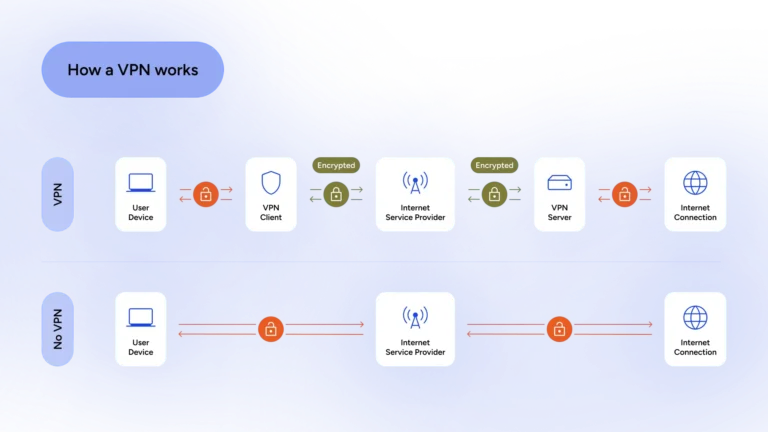
A VPN encrypts the internet traffic on your device as soon as you hit “Connect.” The app, or more technically, the VPN client, encrypts your data*,* generates a key, and sends it to the VPN server in the selected location.
Then, the server decrypts the data with the same key and directs it to the target website or service. This process repeats when the requested data is being transferred back to your device. This time, the server encrypts the data, and the app on your device decrypts it.
This encryption prevents intermediaries, like your ISP or a hacker, from seeing your data, and that is the core benefit of using a VPN: security and privacy.
On a related note:
VPN vs Free Proxy: Which One Actually Protects Your Privacy
FAQs
Yes, a VPN is strongly recommended in 2026. Cybercrime costs are projected to exceed $10.5 trillion annually, with threats such as account compromise surging 389% and ransomware attacks increasing significantly.
Yes, a VPN offers substantial benefits for routine online activities. It encrypts traffic to prevent ISP logging and third-party tracking, reduces targeted advertising and price discrimination, secures connections on public Wi-Fi, and enables access to geo-restricted content.
Without a VPN, your internet traffic remains unencrypted, and your real IP address is visible.
Does a VPN slow down the internet?
A VPN may introduce a minor slowdown, typically 10–30%, due to encryption overhead and routing through remote servers.