Kuwait VPN Laws: What Residents, Tourists, and Businesses Need to Know
You land at Kuwait International Airport, join the Wi-Fi, and try to call home. The video stutters, a news site refuses to load, and you…
Protect your online privacy and security
Fast, private, and easy to use, get Hidzo on your device and browse freely with one tap.
Get HidzoVPN You land at Kuwait International Airport, join the Wi-Fi, and try to call home. The video stutters, a news site refuses to load, and you wonder whether the fix you have in mind is even allowed.
The good news is that yes, you can say it out loud that Kuwait VPN laws allow you to open your VPN and tap Connect. But when you’re connected, you should be cautious about what you do. We’re here to discuss that and give you a safe-use checklist at the end.
Table of Contents
Is Using a VPN Legal or Illegal in Kuwait?
Before we get into statutes and penalties, it helps to separate two ideas that often get blurred together: owning a VPN and what you do with it. Everything below builds on that split.
The Short Answer
Is VPN illegal in Kuwait? No. We found no statute that criminalizes VPN technology, and commentary on Kuwait’s main internet laws notes that none of them mentions VPN tools by name. We also found no licensing or registration requirement for personal use.
Why You Keep Hearing “Yes, But”
Legal status follows the activity rather than the software, a pattern across the region and the main idea behind our guide to VPN legality.
Take two examples. Logging in to your bank from hotel Wi-Fi through a VPN is ordinary online security. Using that same VPN to reach an offshore gambling site is a different story, because gambling is prohibited in Kuwait and the VPN changes nothing about that.
So is it illegal to use a VPN in Kuwait to reach a blocked site? There is no VPN-specific offense. Still, bypassing a block to reach prohibited content can add to your problems, and the activity itself still counts.
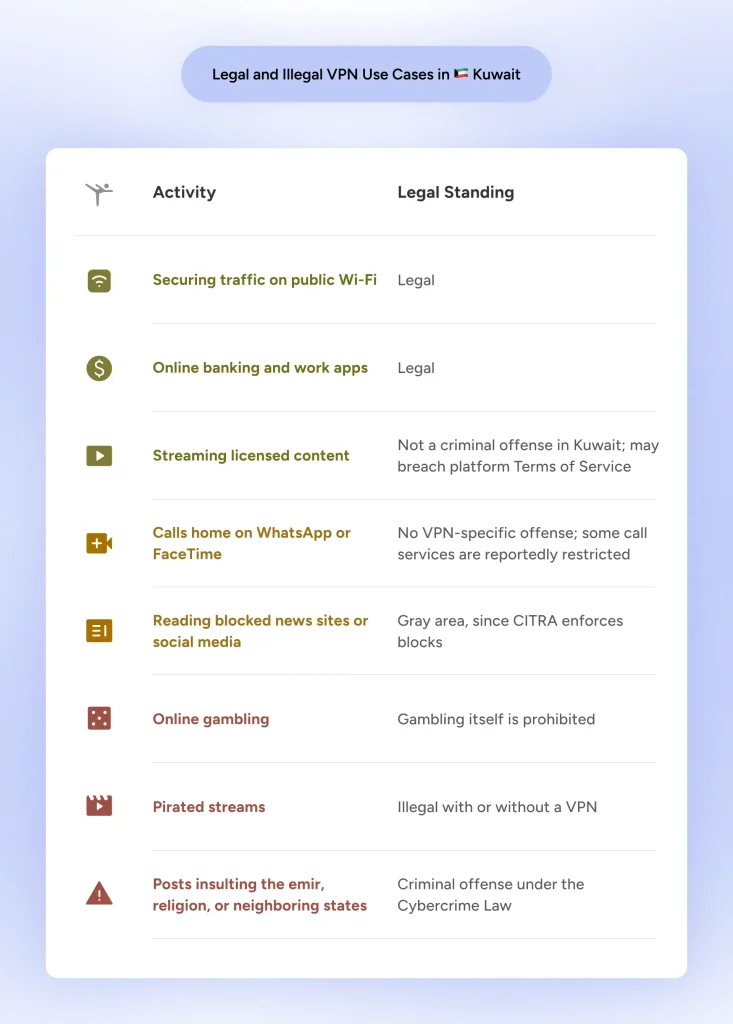
This infographic shows how common activities stack up when you run them through a VPN.
What Are the VPN Laws and Regulations in Kuwait?
There are no standalone VPN regulations in Kuwait. Instead, a few general laws shape what you can do online, and your VPN simply inherits whatever liability the underlying activity creates. Once you see how Kuwait VPN laws fit together, most of the scary headlines lose their bite.
The Cyber Laws in Kuwait
Four pieces of the legal puzzle matter most for VPN users, and the table shows what each one covers.
| Law | What It Covers | Why It Matters for VPN Users |
|---|---|---|
| Cybercrime Law No. 63 of 2015 | Hacking, unauthorized access, fraud, online defamation, and content offenses | Applies to what you do online, with or without a VPN |
| CITRA Law No. 37 of 2014 | Created the telecom regulator; licensed providers follow its rules | Explains why certain sites are blocked; does not ban VPNs |
| Penal Code and Press Law | Offenses such as insulting the emir, often used alongside the cybercrime law | Online posts are treated like public statements |
| CITRA data protection regulation | How companies handle personal data | Matters for businesses that route customer data through a VPN |
The Cybercrime Law has been in force since January 2016, and it hits hardest on speech. Human Rights Watch has criticized provisions that allow prison terms and fines for insulting religion or criticizing the emir online.
What Kuwait Blocks and Why
The Communication and Information Technology Regulatory Authority (CITRA) oversees telecoms, and licensed providers follow its blocking rules. That is why internet censorship in Kuwait reportedly targets pornography, gambling, and some politically sensitive content, so blocked websites in Kuwait tend to fall into those groups.
Voice calls are murkier. Some sources say WhatsApp, Skype, and FaceTime calls are blocked, while others describe throttling at busy hours or on certain carriers. Experience varies by network, so test your own setup instead of trusting a blanket claim.
Unlike neighboring countries such as the UAE, Kuwait does not enforce a blanket nationwide ban on VoIP calls, which is why standard calls often connect without a VPN at all.
As for VPN restrictions in Kuwait, they tend to show up as slowdowns rather than bans. Networks that use deep packet inspection can spot and slow certain VPN protocols, which is why a connection that works at breakfast may stutter by dinner.
Fines and Penalties
There is no fine for using a VPN on its own. Penalties attach to the offense underneath, and the numbers can be steep. Legal guides summarizing the Cybercrime Law describe up to six months in prison and fines of KWD 500 to 2,000 for basic unauthorized access, rising to up to three years and KWD 3,000 to 10,000 when confidential government or financial systems are involved. That climbs to up to ten years and KWD 5,000 to 20,000 when such data is altered, deleted, or disclosed.
Speech is where most real-world cases land. Kuwaiti courts have jailed people over online posts about the emir and other leaders, including accounts run under pseudonyms. A VPN does not rewrite that outcome.
This article is general information, not legal advice. If you face a specific situation, a Kuwaiti lawyer is the right call.
Is VPN Use Legal for Tourists, Residents, and Businesses in Kuwait?
The same laws apply to everyone, but your reasons for connecting differ, and so do the risks that matter most.
Tourists
A VPN for tourists in Kuwait is treated like any other, and the same content laws apply to you from the moment you land. Set up and test your app before the trip, so you are not fiddling with settings at the arrivals gate.
VPN apps are available on Kuwait’s Apple App Store and Google Play Store and will not cause issues at airport customs, though installing beforehand saves you from troubleshooting on airport Wi-Fi.
Hotels, malls, and cafes all offer public Wi-Fi, which is exactly where a VPN earns its keep. It encrypts your traffic while you check email, book a taxi, or log in to a bank back home.
Residents and Expats
It’s legal to use a VPN as a tool. A video chat with family, a remote-work login, or a subscription from your home country raises no VPN-specific problem.
Where residents get into trouble is content, not connections. Posts about rulers, religion, or neighboring countries can trigger prosecution, and courts have convicted people who posted from fake accounts. A VPN protects your connection; it does not make you anonymous, so your online privacy in Kuwait still depends on what you choose to post.
Businesses
Companies use VPNs every day in Kuwait. Banks, government offices, and private firms rely on them so staff can reach internal systems securely, and we found no special license requirement for that. A Kuwait City accounting team working from home, or a retailer linking a branch abroad to head office, are textbook examples.
For teams, a dedicated business VPN adds access controls and central management that a consumer app lacks.
Businesses also have to respect Kuwait’s data protection rules, which CITRA oversees. If your VPN carries customer data, make sure your provider’s logging and storage practices fit those duties.
A Practical Safe-Use Checklist
Run through these before you connect.
- Choose a provider with a clear, audited no-logs policy.
- Switch on the kill switch so your traffic never slips out if the tunnel drops.
- Use split tunneling to keep local banking apps and Kuwaiti government services like Sahel or Kuwait Mobile ID on your normal connection, as they often block foreign IP addresses.
- Pick a provider with several protocol options, in case one gets throttled.
- Skip free VPNs that pay their bills with your data.
- Never lean on a VPN to cover activity that is illegal anyway.
HidzoVPN includes a kill switch, split tunneling, and a strict no-logs policy, so local apps stay local while everything else rides the tunnel. You can grab the VPN app before you travel and test it at home first.
The Bottom Line
So, is VPN legal in Kuwait? Yes. VPN legality in Kuwait rests on one idea: the tool is fine, and the activity decides your risk. Keep your use lawful, choose a trustworthy provider, and treat every online post as a public statement.
Do that, and a VPN is a sensible way to protect your privacy, whether you are a tourist, a resident, or a business owner.
FAQs
No. Individuals and companies can legally use VPNs, and VPN apps remain available on Kuwait’s app stores. While certain websites are blocked and some VPN protocols slow down on networks that inspect traffic, switching protocols or servers usually resolves it.
Often, no. Local banks and government platforms such as Sahel and Kuwait Mobile ID frequently block traffic from foreign servers, so route those apps outside your VPN tunnel using split tunneling.
Yes. The same content laws apply to you as to residents, so install and test your app before you arrive.
Not for the VPN alone. Fines and prison terms attach to the underlying offense, such as unauthorized access or illegal online content.
Using a VPN for personal calls is not a VPN-specific offense. Reports on call restrictions conflict, so test calls on your own network and pick a server that gives a stable connection.
If you connect through a company VPN, your employer can usually see traffic that passes through its network. A personal VPN on your own device is separate, so keep work and private browsing apart.
Free VPNs are legal, but many limit speed, cap data, or earn money from your data. For anything sensitive, a provider with a clear no-logs policy is the safer pick.
Article by
-
 Sam Clarke
Sam is a cybersecurity and online privacy writer dedicated to making complex network protection accessible, practical, and engaging.





Share your thoughts
Add a comment