What Are the Bahrain VPN Laws? Should You Be Worried?
You land in Manama, open your phone, and suddenly a quiet worry shows up: is VPN legal in Bahrain, or are you about to turn…
Protect your online privacy and security
Fast, private, and easy to use, get Hidzo on your device and browse freely with one tap.
Get HidzoVPN You land in Manama, open your phone, and suddenly a quiet worry shows up: is VPN legal in Bahrain, or are you about to turn a harmless privacy tool into a very awkward conversation? Most people never get a straight answer, because the internet is full of pages that confuse “blocked” with “banned” and then jump to a sales pitch.
As far as published sources show, Bahrain has no law that bans VPNs as such, but the country does punish crimes committed online, and a VPN will not change that. The rest of this guide sorts the safe uses from the shaky ones, so you can connect with confidence instead of guessing.
Table of Contents
Bahrain VPN Laws
Using a VPN in Bahrain is generally treated as legal. Comparitech’s global tracker lists Bahrain among the countries where VPN use is allowed, even though the country filters parts of the internet. That fits the wider VPN legality picture across the Gulf, where the tool is tolerated, and the behavior behind it is what gets judged.
Using a VPN in Bahrain is no different than owning a car. Having one is normal, but driving it through a shop window is not, and no one accepts “my car did it” as a defense. Keep that image in mind, because the rest of this article keeps returning to it.
Blocked Is Not Banned
Many searches for a VPN ban in Bahrain come from one experience: someone tries to open a VPN provider’s website and it will not load. That feels like a ban, but it is a different thing. Authorities in Bahrain have long filtered websites, mostly news, political, and adult content, and the ISPs enforce those lists.
Freedom House reported in earlier editions that the sites of some popular VPN providers were blocked in Bahrain, which made downloading their apps harder. The same reports noted that the VPN apps themselves kept working once installed. Those reports are a few years old, so treat them as background rather than today’s status, and read the original Freedom House coverage if you want the detail.
Some networks go further and try to spot VPN traffic itself. That relies on deep packet inspection, which looks at the shape of your data rather than its contents. VPN providers react with obfuscation, which disguises VPN traffic as ordinary web traffic, so a connection that drops on one network may behave differently on another.
The Laws That Actually Apply
There is no section titled “VPN” in Bahrain’s rulebook. When people ask about Bahrain VPN laws, they are really asking how two older laws handle online behavior. Here is how they line up.
| Law | What It Covers | How It Touches a VPN User |
|---|---|---|
| Telecommunications Law (Decree 48 of 2002) | Licensing of telecom services, network use, and penalties for misuse | Providing unlicensed telecom services and misusing networks can be punished |
| IT Crimes Law (Law 60 of 2014) | Unauthorized access, interception, electronic fraud, and encryption used to hide a crime | A VPN offers no protection if the underlying act is an offence |
| Content Rules (Press and Penal Provisions) | Material considered offensive, false, or harmful to public order | What you publish or share online can still be prosecuted |
The Telecommunications Law requires a license before anyone provides a telecom service in the Kingdom, and it carries penalties for misusing the network. You can browse the English text on WIPO Lex. Enforced by Bahrain’s Telecommunications Regulatory Authority (TRA), the rulebook is aimed at unlicensed operators and network abuse, not at someone encrypting their own connection on a train.
The IT Crimes Law matters more for everyday users. A published summary puts fines for unauthorized access at up to BD 30,000, alongside possible prison time. It also criminalizes using encryption to commit or conceal a crime, which is the clause that gets quoted most often in VPN debates.
That clause deserves a careful read. It targets encryption used with criminal intent, not encryption in general. Human rights observers have argued that “criminal intent” could be interpreted broadly in political cases, so it is worth knowing that the wording leaves room for judgment.
The Tunnel Is Not the Crime, the Act Is
The cleanest way to think about all of this is to separate the tool from the action. A VPN encrypts your connection and swaps your visible IP address. Neither of those things is a crime. What you do next might be.
Take two examples. Someone who uses a VPN to attempt bank fraud has committed fraud, and the VPN adds nothing to their defense. Someone who uses a VPN on café Wi-Fi to check email has simply protected their data.
One more point is easy to miss. Bahraini telecom companies have reportedly been required since 2009 to keep records of customers’ calls, emails, and website visits for up to three years. A VPN hides your activity from your ISP, but it does not make you invisible to everything, and it should never be treated as a cloak for risky behavior.
The Traffic-Light Guide to Common VPN Uses in Bahrain
Rules are easier to remember when they have colors. This table sorts common uses into green, amber, and red. It is general information, not legal advice, and local rules can change.
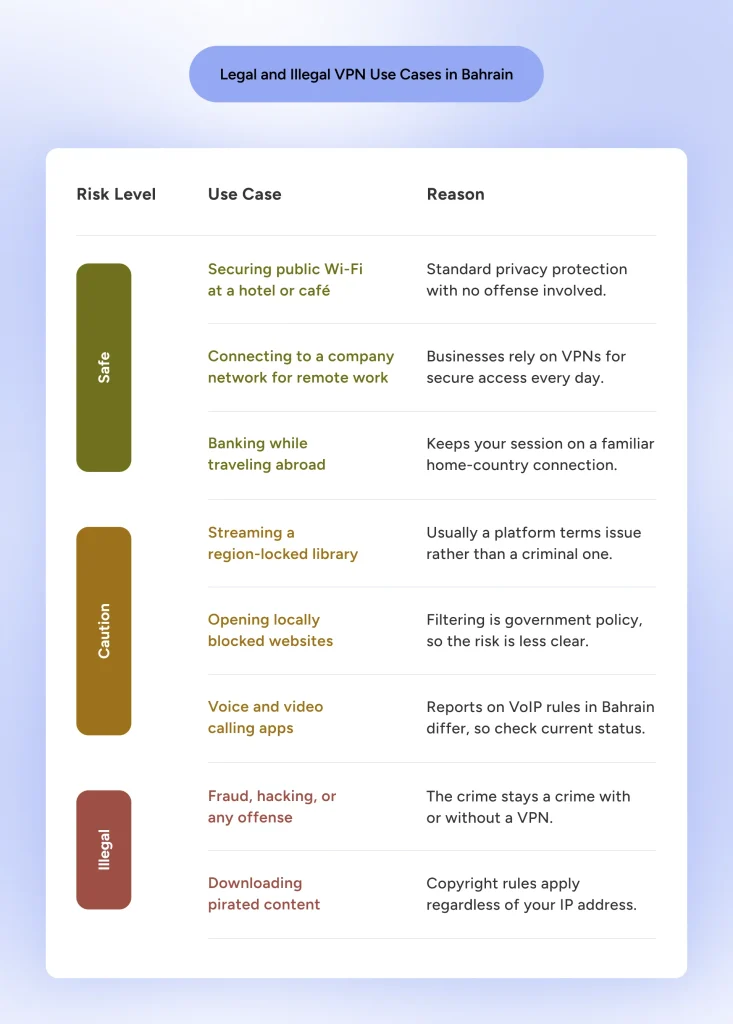
A few of these rows need extra context. Streaming platforms can restrict or close accounts that break their terms, but that is a contract matter between you and the service. Blocked local sites are murkier, because the filtering is state policy and people disagree about how far enforcement reaches.
Calling apps are the most misunderstood row on the chart. Unlike the UAE, Bahrain generally does not block standard consumer VoIP calls on apps like WhatsApp or FaceTime, though the TRA restricts unlicensed commercial VoIP services. Because platform availability can shift by network, test your calls on arrival rather than buying a VPN solely for voice chat.
Residents vs. Visitors: What Changes at the Airport
Visitors face a practical problem more than a legal one. If a VPN provider’s website is filtered in Bahrain, you may not be able to download or sign in once you arrive. Install and test your app at home, pick the server you want, and make sure it connects before boarding.
A reliable VPN app on your phone and laptop before you land saves a lot of frustration at the baggage carousel. If you are hopping around the region, our guide to the best VPN for Gulf countries covers what changes from one country to the next.
Residents and expats have a slightly different checklist. Your employer may require its own VPN for company files, and mixing that with a personal VPN can cause connection clashes. Your home internet contract may also include terms about network use, so skim it once and move on.
Both groups share the same baseline. Use a VPN for privacy, security, and ordinary access, and skip anything you would not do without one. That single habit covers most of the risk.
Legal Does Not Mean Safe
You can follow every rule and still get burned by the wrong provider. The biggest risk is not a Bahraini regulator; it is a careless VPN that treats your data as a product.
Free apps are the usual culprit. Many pay their bills with ads, trackers, or by selling activity data, which defeats the point of using a VPN. If you are weighing a no-cost option, read whether free VPNs are safe before you install anything.
Your Pre-Connect Checklist
Before you connect in Bahrain, run through this short list.
- Install and test your VPN before you travel, not at arrival.
- Use it for privacy, work, and banking, which are the green-light uses.
- Skip anything illegal, because a VPN will not protect you from a charge.
- Check streaming and calling rules rather than assuming they work.
- Choose a provider with a clear no-logs policy and avoid anonymous free apps.
- Turn on the VPN kill switch so a dropped tunnel never exposes you.
Disclaimer
Laws and enforcement can change, so if your situation is complex, such as running a business or handling sensitive work, talk to a qualified local lawyer. For everyone else, the rule of thumb holds. The VPN is the easy part, and your behavior is what the law looks at.
FAQs
Generally yes. Published sources do not point to a law that bans VPN use, though crimes committed through a VPN are still punishable.
Usually no. Standard personal voice and video calls on major apps generally work on Bahraini networks without a VPN, though rules focus on blocking unlicensed commercial VoIP providers.
Bahrain filters certain websites, and earlier reports noted that some VPN provider sites were blocked. VPN apps themselves were reported to keep working, but results vary by network.
Tourists are generally treated the same as residents. Install your app before arrival, since provider websites may be filtered locally.
There is no dedicated VPN rulebook. The Telecommunications Law and the IT Crimes Law set the limits, and they focus on misuse rather than on the tool.
Free VPNs are more likely to cause privacy problems than legal ones. They may log or sell your data, so choose a provider with a clear no-logs policy.
Rarely. Almost no reputable VPN providers run physical servers in Bahrain, though a handful offer virtual locations. A VPN in Bahrain is best used for encrypting local connections or accessing servers abroad.
Article by
-
 Sam Clarke
Sam is a cybersecurity and online privacy writer dedicated to making complex network protection accessible, practical, and engaging.





Share your thoughts
Add a comment