Is VPN Legal in Oman? Laws, Restrictions, and Fines
If you’ve seen how Omanis or visitors to Oman use VPN apps, you’ll think it’s quite normal, but that’s not in line with what the…

Protect your online privacy and security
Fast, private, and easy to use, get Hidzo on your device and browse freely with one tap.
Get HidzoVPN If you’ve seen how Omanis or visitors to Oman use VPN apps, you’ll think it’s quite normal, but that’s not in line with what the official law says. So, on the one hand, we have VPN users in Oman like it’s nothing, and on the other hand, we have the legal technicalities that can easily trap you if you disregard them.
The reality sits in a legal gray area. Oman strictly regulates encryption technology, yet its laws do not explicitly name every modern consumer VPN app or impose a blanket criminal ban on opening one. Knowing where the law draws the line and what actually triggers penalties can save you from both security risks and legal confusion.
| Aspect | Status in Oman | Key Takeaway |
|---|---|---|
| Personal VPN Use | Gray Area | Encryption requires a license on paper, though consumer VPN apps are not explicitly named in statute. |
| Business VPN Use | Permitted with Compliance | Organizations use encrypted networks, provided they align with Telecommunications Regulatory Authority (TRA) rules. |
| Automatic “VPN Fine” | No Fixed Consumer Fine | The rumored 500 OMR (~$1,300) fine comes from an unadopted 2010 draft, not active law. |
| 2026 Cybercrime Law | Intent-Based | Using a VPN or encryption to commit a crime or hide digital evidence is a criminal offense. |
| Blocked Services & VoIP | Restricted | A VPN may bypass technical blocks on calling apps, but it does not make restricted activity lawful. |
Table of Contents
Is Using a VPN Legal or Illegal in Oman?

If you are looking for a simple yes-or-no answer, Omani law does not offer one. Instead, Oman regulates encryption, which happens to be the core technology every VPN uses to tunnel and protect your internet traffic.
Because the law targets encryption systems broadly rather than naming commercial VPN apps, using a VPN is neither explicitly authorized for everyday consumers nor automatically treated as a standalone crime. In practice, authorities and legal observers separate three distinct factors:
- The technology: A VPN encrypts data traveling between your device and a remote server.
- The regulatory framework: Omani telecommunications rules place licensing conditions on encryption systems and cryptographic software.
- Your online activity: Using an encrypted connection to access prohibited content, bypass telecom regulations, or commit an offense creates direct legal liability, with or without a VPN.
Connecting to an employer-approved VPN to check work email on Muscat hotel Wi-Fi is very different from using a VPN to conceal unlawful activity. Availability in an app store does not mean unrestricted legal permission, so understanding the underlying laws matters.
What Are the VPN Laws and Regulations in Oman?
Three main legal instruments shape how VPNs and encryption are treated in Oman. Reading them together prevents the common mistake of assuming Oman has a single, all-encompassing “VPN ban.”
1. Article 48 of the Telecommunications Regulatory Act
Under Article 48 of Oman’s Telecommunications Regulatory Act (Royal Decree No. 30/2002), encryption cannot be used in telecommunications or between computer networks without a license from the Minister. That license sets out who may operate an encryption system and under what conditions.
Because VPNs rely on encrypted connections, Article 48 sits at the center of the debate. However, the text was written for telecom infrastructure and network operators, and it does not mention personal VPN subscriptions or explain how an individual user connecting to an overseas server should be licensed.
2. TRA Decision No. 37/2008 on Encryption Controls
Issued by the Telecommunications Regulatory Authority (TRA), Decision No. 37/2008 governs the import, export, and use of encryption systems and equipment. Article 2 prohibits the personal use of cryptographic software, specifically naming PGP, and cryptographic hardware, while carving out an exception for SSL (the standard encryption used by secure websites).
While a consumer VPN is not identical to PGP, both rely on cryptographic software to shield communications. Because Decision No. 37/2008 uses broad language and predates modern consumer VPN apps, personal VPN use remains legally ambiguous.
3. Oman’s Cybercrime Law (Royal Decree No. 61/2026)
Oman enacted a modernized Cybercrime Law under Royal Decree No. 61/2026 (issued on June 1, 2026, published in Official Gazette No. 1651 on June 7, and effective June 8, 2026), replacing Royal Decree No. 12/2011.
Article 12 of the 2026 law makes it a crime to possess, create, import, sell, or distribute devices, software, tools, passwords, or codes when intended to commit or facilitate a cybercrime or conceal digital evidence. That requirement of criminal intent is crucial: simply having a standard VPN app installed on your phone is not defined as a cybercrime under Article 12, whereas using a VPN to facilitate an offense clearly is.
What About VPN Fines and Penalties?
Many online guides claim that anyone caught using a VPN in Oman faces an automatic 500 OMR (roughly $1,300) fine. That figure traces back to an August 2010 TRA consultation draft that proposed banning individual VPNs, a draft that never became law. Neither Omani statutes nor the TRA’s public statements establish a flat, automatic fine simply for opening a consumer VPN app.
That does not mean penalties do not exist. Real legal consequences apply when encryption or internet tools cross into prohibited territory:
- Cybercrime offenses: Under Royal Decree No. 61/2026, using technology to commit online fraud, unauthorized system access, privacy violations, or prohibited content offenses carries prison sentences and fines ranging from 1,000 OMR to over 10,000 OMR, depending on the crime.
- Unlicensed telecom or encryption operations: Violating licensing rules under the Telecommunications Regulatory Act (Royal Decree No. 30/2002) exposes offenders to statutory fines and potential imprisonment.
Restrictions on Websites, Apps, and VoIP Calls
Oman regulates internet calling (VoIP) services, such as WhatsApp voice and video calls, through local telecom licensing rules, which is why unlicensed calling features are frequently unavailable on local networks.
Similarly, access to social platforms can fluctuate; in April 2025, for instance, the TRA stated that it had not formally banned TikTok and attributed access disruptions at the time to technical issues, though availability on local networks has continued to vary.
While a VPN routes your traffic through a server outside Oman and may technically restore access to restricted features, changing your virtual location does not change local law. You remain subject to Omani regulations for everything you access or transmit while physically inside the country.
Is VPN Use Legal for Tourists, Residents, and Businesses?
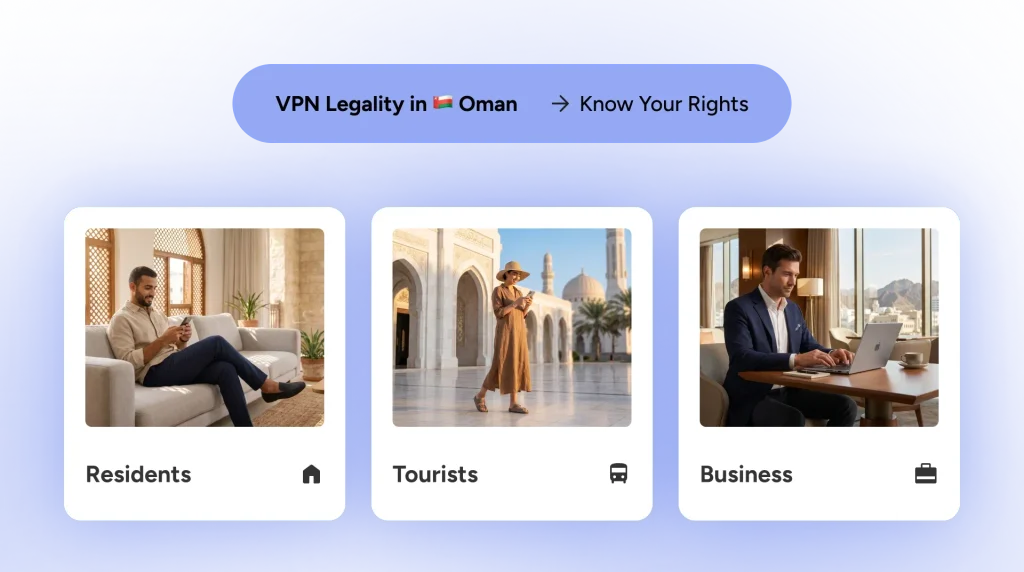
Oman’s telecommunications and cybercrime laws apply to everyone within the country’s borders, though practical risk looks different depending on why you are connecting.
| User Group | Legal Reality in Oman | Best Practice |
| Tourists & Visitors | Subject to the same encryption and cybercrime rules as locals; no tourist exemption exists. | Use only employer-provided VPNs for work and avoid bypassing local content restrictions. |
| Residents & Expats | Residency visas and local SIM cards do not authorize personal encryption software. | Do not assume a working VPN connection equals legal permission to access blocked services. |
| Businesses & Organizations | Corporate VPNs are standard for internal security, subject to regulatory compliance. | Verify network setups with local legal and technical advisers to ensure TRA compliance. |
- Tourists and Short-Term Visitors: Being a visitor does not exempt you from local rules. If you need to reach company systems while traveling, stick to your employer’s official VPN setup rather than downloading random consumer apps on hotel Wi-Fi.
- Residents and Expatriates: Long-term residents use local telecom networks governed by TRA licensing rules. Even if a VPN connects smoothly on a home fiber line or mobile data plan, using it to circumvent local service restrictions still carries regulatory risk.
- Businesses and Organizations: Companies operating in Oman routinely rely on encrypted tunnels to connect branch offices and remote staff. However, corporate status does not waive licensing obligations. Organizations deploying encryption infrastructure or commercial telecom services should confirm compliance with qualified Omani legal counsel.
Is It Safe to Use a VPN in Oman?
Evaluating VPN safety in Oman requires looking at both cybersecurity and legal exposure.
On July 6, 2026, Oman’s Telecommunications Regulatory Authority issued a public advisory warning users about the risks of untrustworthy VPN applications. The regulator highlighted that many dubious VPN apps demand excessive device permissions, secretly log user activity, track or sell personal data, inject malware that steals banking credentials, or redirect users to phishing sites. The TRA urged the public to stick to official app stores, scrutinize app permissions, and comply with Omani regulatory frameworks.
To protect your data and minimize risk while in Oman, follow these five practical steps:
- Avoid shady free VPN apps: Free, unverified VPNs frequently monetize your browsing data or expose your device to malware.
- Download software before you travel: Install a reputable VPN app from official app stores (Apple App Store or Google Play) prior to arrival, as VPN websites themselves can be inaccessible locally.
- Audit app permissions: Deny access to contacts, location, or storage if a VPN app has no legitimate technical reason to request them.
- Use employer-managed tools for work: If you are connecting for business, rely on your organization’s IT-approved security client rather than a personal subscription.
- Never use a VPN for unlawful activity: Avoid using any encryption tool to access prohibited material, spread restricted content, or violate Oman’s 2026 Cybercrime Law.
Final Verdict
Oman’s approach to VPNs comes down to how it regulates encryption and online conduct rather than a single rule naming VPN apps. Treating technical access with caution, steering clear of untrustworthy free apps, and seeking qualified Omani legal advice if your business or personal situation requires certainty remain the smartest ways to stay protected.
FAQs
Oman does not explicitly authorize consumer VPNs, nor does it list every VPN app in a blanket criminal ban. Instead, Article 48 of the Telecommunications Regulatory Act and TRA Decision No. 37/2008 restrict unlicensed encryption, leaving personal VPN use in a legal gray area.
No enacted Omani law sets an automatic 500 OMR (~$1,300) fine simply for opening a consumer VPN app. That widely repeated figure comes from an unpassed 2010 TRA consultation draft. However, using a VPN to commit cybercrimes or violate telecom regulations can lead to severe fines and imprisonment.
Oman does not block every VPN service nationwide, though individual servers or protocols can fail due to local ISP filtering, network configurations, or technical outages. A connection that works technically is not proof of legal authorization.
Tourists are subject to Oman’s telecommunications and cybercrime laws just like residents. Visitors who need a VPN for remote work should use their employer’s approved security setup and avoid using personal VPNs to bypass local restrictions.
Yes, in practice. While the broader telecommunications framework covers everyone, businesses routinely operate managed corporate VPNs for internal communications, provided their setups comply with TRA rules. Personal encryption software lacks clear regulatory approval.
Potentially, yes. A VPN masks your IP address, but it does not exempt you from Omani law. Using a VPN to bypass VoIP licensing rules or access prohibited content can expose you to regulatory or criminal consequences depending on the activity.
Article by
-
 Sam Clarke
Sam is a cybersecurity and online privacy writer dedicated to making complex network protection accessible, practical, and engaging.





Share your thoughts
Add a comment