VPN vs Free Proxy: Which One Actually Protects Your Privacy
Proxies and VPNs are mainly used to access restricted content, but they’re apples and oranges. A VPN offers several more vital features to users compared…

Protect your online privacy and security
Fast, private, and easy to use, get Hidzo on your device and browse freely with one tap.
Get HidzoVPNTable of Contents
Proxies and VPNs are mainly used to access restricted content, but they’re apples and oranges. A VPN offers several more vital features to users compared to a free proxy. Basically, a free proxy can give you access to geo-blocked content, but a VPN not only gives you unrestricted internet access, but it also hides what you’re doing online. Let’s find out why a trusted VPN is your best friend and a free proxy is a privacy assassin.
What’s a VPN?
A Virtual Private Network or VPN consists of users’ devices (laptop, cell phone, tablet, etc.) connected to a VPN server. When you’re using a VPN, your device’s internet traffic doesn’t pass through your ISP directly. It is transferred to the VPN server in a tunnel that separates your data from other data on your network.
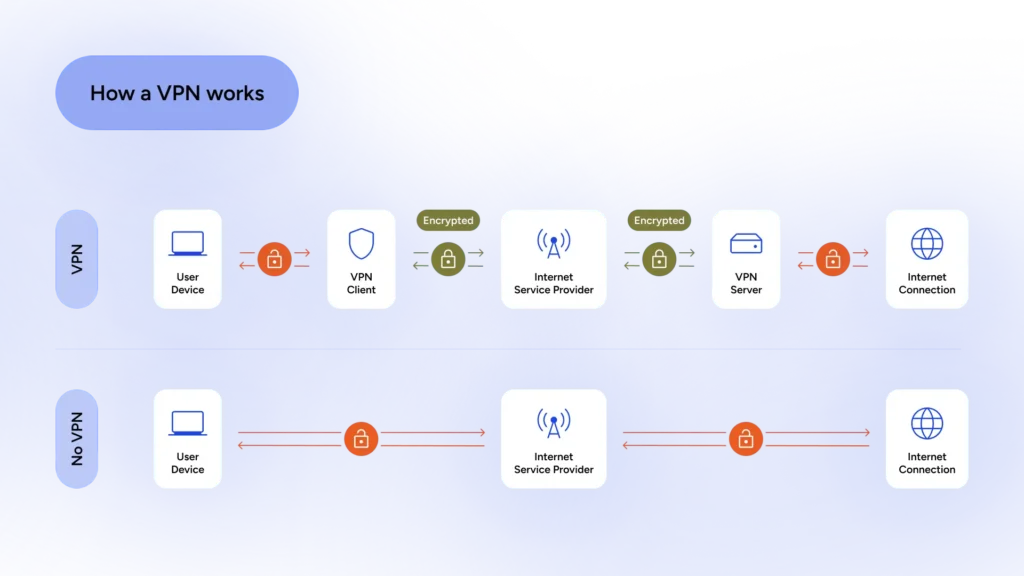
As you can see in the graph, the VPN app on your devices encrypts your data and sends it to the server. Then, the server decrypts the data and sends it to the target website or platform. Again, once the requested data is sent back to you, the VPN server encrypts it, and the app on your device decrypts it. How the encryption works and how data is transferred is determined by the VPN protocol. Currently, OpenVPN and WireGuard are two of the popular VPN protocols.
The Pros and Cons of a VPN
Using a VPN is a necessity when you go online. The I-have-noting-to-hide approach just doesn’t work anymore because your privacy is at stake when you’re not protected with a VPN. Plus, the pros you get with using a VPN significantly outnumber the cons.
| Pros | Cons |
|---|---|
| Security of personal data with unbreakable encryption | Potential speed reduction due to encryption and VPN server overhead |
| Privacy protection on public networks | Might be illegal in some countries |
| Prevention of ISP surveillance or hacker attacks | – |
| Access to geo-blocked content | – |
| User anonymity through IP masking | – |
Choosing the Right VPN
Just search “VPN” on App Store or Play Store, and you’ll see that choosing a reliable VPN that works is the hardest part of using a VPN. You should consider three points before choosing a reliable VPN app.
First things first! You shouldn’t go after free VPN apps because they either bombard you with ads or snoop on your online activities and use the info for marketing purposes. If you can’t or don’t want to pay for a VPN, you should use trusted VPN providers such as Windscribe or HidzoVPN that offer a free plan on the side of their premium subscriptions.
The second point is the pricing. You can find good prices offered by reputable VPN providers, such as NordVPN or SurfShark. However, in order to benefit from their discounts, you must purchase long-term (1 to 3 years) subscriptions. HidzoVPN Premium is available for just $2.99 for a monthly subscription.
Third, you should review the VPN app to see whether it features the necessary VPN options. For instance, a good VPN app (a) allows you to navigate between servers in different locations, (b) features a Kill Switch for nonstop protection, (c) is easy to use, and (d) allows professional users to change connection settings manually. These are the basic features you should look for in a VPN.
What’s a Proxy?
A proxy is basically an intermediary in your internet connection. When using a proxy, your request first goes to the proxy server and then to the target website. Unlike a VPN, when data is being transferred between your device and the proxy server, it’s not encrypted.
There are 2 main types of proxy services based on protocol. The commonest types are HTTP/HTTPS proxies that handle web traffic. They’re typically installed on browsers as extensions and can reduce latency by caching visited websites’ content.
SOCKS proxies operate at a lower level, and they support other protocols, such as TCP and UDP, which makes them suitable for applications like email and file transfer.
The Pros and Cons of a Proxy
Using a proxy server doesn’t protect your privacy, but it isn’t entirely useless. The table below shows what you get and what you miss when using a free proxy.
| Pros | Cons |
|---|---|
| Frequently available at no cost and requires no software installation for web-based options. | May involve hidden costs, such as data logging, advertisements, or malware exposure. |
| Bypassing simple geo-restrictions for websites | Doesn’t route all device traffic; just web content |
| Often incurs minimal overhead for targeted tasks, potentially maintaining higher speeds. | Doesn’t route all device traffic; just web content |
| – | Does not encrypt traffic |
| – | Susceptible to ISP surveillance |
| – | Limited to specific protocols |
VPN vs Free Proxy: Which One Works Best?
Choosing between a proxy server and a VPN depends on your needs, but for an all-in-one solution, you should use a reputable VPN. The table below summarizes what you get with each of these tools.
| Aspect | Proxy Server | Typically subscription-based, some VPNs offer a free tier (with ads) |
|---|---|---|
| Scope of Traffic | Does not affect all device traffic. | Encrypts and routes all internet traffic from the device |
| Encryption | Offers basic or no encryption at all | Provides end-to-end encryption for all data |
| Security Features | Limited to IP masking; susceptible to leaks | Includes advanced features like kill switches |
| Privacy Level | Exposes traffic to the proxy provider | Masks IP and hides traffic from ISPs and third parties |
| Performance Impact | Generally faster for targeted tasks | May introduce slight latency due to encryption |
| Cost and Reliability | Often free or low-cost, but prone to downtime, ads, and data selling | Typically subscription-based, some VPNs offer free tier (with ads) |
| Use Cases | Suitable for simple tasks like bypassing basic geo-restrictions or accessing blocked websites | Ideal for comprehensive needs, such as secure remote work, safe public Wi-Fi usage, or evading advanced censorship. |
FAQs
A VPN is better because it includes all the features of a proxy plus several more options, like data encryption and privacy protection.
When you use a proxy, your data is visible to the proxy provider, and they might steal your data, including your passwords, or use it for marketing purposes.
Yes, it is possible to chain a proxy with a VPN for added layers of redirection, but this may reduce connection speeds and increase complexity.
Yes, proxies can be configured on mobile devices via browser extensions, dedicated apps, or system network settings.
Article by
-
 Sam Clarke
Sam is a cybersecurity and online privacy writer dedicated to making complex network protection accessible, practical, and engaging.





Share your thoughts
Add a comment