VPN for Travelers: Find the Fastest One for Your Destination
Using travel Wi-Fi without a fast travel VPN is like trying to win a Formula 1 race on a tricycle; it’s dangerous and embarrassingly slow….

Protect your online privacy and security
Fast, private, and easy to use, get Hidzo on your device and browse freely with one tap.
Get HidzoVPNTable of Contents
Using travel Wi-Fi without a fast travel VPN is like trying to win a Formula 1 race on a tricycle; it’s dangerous and embarrassingly slow. Between AI-powered “Evil Twin” hotspots waiting to snatch your passwords and aggressive geo-blocks stopping you from finishing your favorite show, your choice of VPN can make or break your trip.
If you’re in a rush to catch a flight, here is your boarding pass to privacy:
- NordVPN is currently the speed champion of 2026, retaining about 95% of its base speed thanks to its NordLynx protocol.
- For those traveling with a suitcase full of gadgets, Surfshark offers the best value with unlimited connections.
- ExpressVPN remains the gold standard for easy, one-tap security.
- HidzoVPN is for users who want a lightweight app that is easy on the battery, but delivers the same privacy protection as the above options.
The “Must-Have” Travel VPN Features
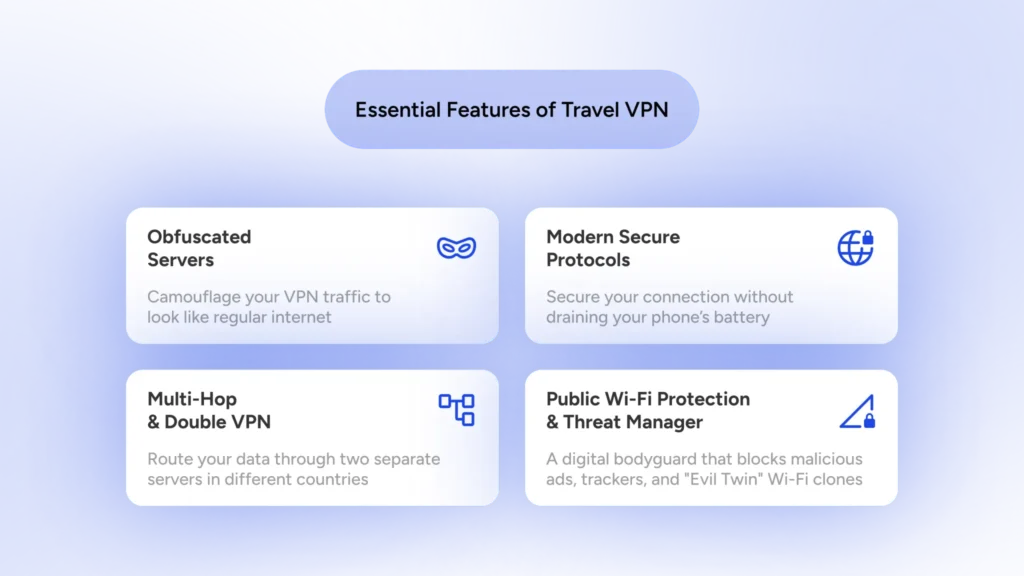
Choosing a VPN for travel without checking its features is like packing a fur coat for a trip to the Sahara. Technically, you have “clothes,” but you’re going to have a bad time. The digital landscape is changing faster than a tourist’s mind after seeing the exotic dish they ordered. Depending on your destination, you’ll need specific tools to ensure your connection remains as smooth as silk. Here is the regional breakdown of the tech your VPN must have:
1. The “Stealth Mode”: Obfuscated Servers
Best For: The Middle East (UAE, Saudi Arabia) and East Asia (China, Vietnam).
Why You Need It: In these regions, governments use “Deep Packet Inspection” to sniff out VPN traffic. Obfuscated servers act like a digital cloaking device, making your VPN data look like regular, innocent web browsing.
2. The “Border Buster”: Multi-Hop & Double VPN
Best For: Eastern Europe and Restrictive Regimes.
Why You Need It: If you’re a digital nomad handling sensitive work info, one layer of encryption isn’t enough. Multi-hop bounces your traffic through two different countries. It’s like wearing two pairs of sunglasses; it might seem like overkill until the sun (or a hacker) is staring you right in the face.
3. The “Safe-Pass”: Public Wi-Fi Protection & Threat Manager
Best For: Western Europe and North America.
Why You Need It: You might not face government firewalls in Paris or New York, but you will face “Evil Twin” hotspots. Hackers set up these fake Wi-Fi networks that look exactly like “Starbucks_Guest.” A VPN with a built-in Threat Manager acts like a digital bodyguard, slapping away malicious ads and blocking known tracking sites before they can ruin your day.
4. The “Battery Saver”: WireGuard & Lightway Protocols
Best For: Everywhere (especially on long transit days).
Why You Need It: Older VPN protocols are battery vampires; they’ll suck your phone dry faster than a toddler with a juice box. Protocols like WireGuard (NordVPN) or Lightway (ExpressVPN) are incredibly lightweight, meaning you can stay protected during a 12-hour layover without desperately hunting for a charging port.
Pro Tip: Always enable your Kill Switch. If your VPN connection drops for even a millisecond in a place like China, your real IP address will leak, and you might find yourself suddenly locked out of your favorite apps. It’s the digital equivalent of accidentally leaving your fly open.
Top 8 VPNs for Travelers: Detailed Analysis
Now that we know which gadgets to pack in our digital suitcase, let’s look at the apps that actually deliver. We’ve handpicked these VPN providers based on the regional needs we discussed, pairing them with the specific features that will keep you from pulling your hair out in a foreign airport.
1. The “Stealth Mode” Specialists (Middle East & East Asia)
Best for: Bypassing “The Great Firewall” and strict government blocks.
- Astrill VPN: If VPNs were cars, Astrill would be a rugged 4×4 built for the desert. It is the “nuclear option” for China and the UAE. Its proprietary StealthVPN protocol works perfectly to bypass deep packet inspection. It’s pricier than most, but when every other VPN fails, Astrill usually keeps chugging along.
- Surfshark: Don’t let the friendly interface fool you; this shark has teeth. Its NoBorders mode automatically detects if you’re on a restrictive network and gives you a curated list of servers that can break through. It’s the perfect “set-and-forget” option for travelers moving between the West and more restrictive regions.
2. The “Border Busters” (Eastern Europe & High-Risk Zones)
Best for: Journalists, activists, or anyone handling sensitive work data.
- NordVPN: The king of versatility. Their Double VPN (Multi-Hop) feature doesn’t just encrypt your data once; it sends it through two separate servers in two different countries. It’s like wearing a disguise over your disguise. If a hacker manages to crack one layer (highly unlikely), they’re still staring at another wall of steel.
- Mullvad VPN: The “James Bond” of the list. Mullvad doesn’t even ask for your email address; they just give you a random account number. Their Multi-Hop setup is incredibly transparent, allowing you to pick exactly which two cities your data travels through. It’s radical privacy for those who don’t want to leave a single digital footprint.
3. The “Safe-Pass” Bodyguards (Western Europe & North America)
Best for: Safe browsing on sketchy hotel, airport, and café Wi-Fi.
- ExpressVPN: In the world of public Wi-Fi, ExpressVPN is like having a professional bodyguard who also happens to be a world-class sprinter. Their Threat Manager prevents apps and websites from communicating with known trackers or malicious third parties. It’s remarkably easy to use, making it ideal for the “I just want it to work” traveler.
- Proton VPN: This provider prioritizes security, and their NetShield feature acts as a massive filter for your internet, scrubbing away ads, trackers, and malware before they even reach your device. It’s perfect for exploring European cities where every “Free Wi-Fi” spot feels like a trap.
4. The “Battery Savers” (The Long Haul)
Best for: 12-hour flights and layovers where charging ports are a myth.
- HidzoVPN: If you’ve ever seen your battery percentage drop faster than your mood at a delayed flight gate, HidzoVPN is for you. It’s designed to be ultra-lightweight, using smart protocols that stay active in the background without making your phone feel like a hot potato. You can get all the essentials of a VPN with HidzoVPN Premium at extremely competitive pricing.

- Private Internet Access (PIA): PIA is a veteran in the industry, and its efficiency remains top-tier. By allowing you to switch to WireGuard and customize your encryption levels, you can squeeze every last drop of life out of your battery. It’s a great choice for domestic US travelers who are constantly hopping between 5G and airport Wi-Fi.
| VPN | Pros (for travelers) | Cons (for travelers) |
|---|---|---|
| Astrill VPN | • Excellent in restrictive countries (e.g. China) with stealth protocols • Strong obfuscation & censorship bypass • Reliable in high-censorship regions | • Very expensive (~$30/month) • Limited server coverage vs competitors • Weak streaming performance |
| Surfshark | • Budget-friendly with strong global coverage • Unlimited devices (great for multiple gadgets) • Good speeds and simple apps | • Slightly weaker security/streaming vs top-tier rivals • Fewer countries than leaders |
| NordVPN | • Excellent balance: speed, security, and coverage • Great for streaming worldwide • Large server network (100+ countries) | • Price increases on renewal • No port forwarding (limits advanced use) |
| Mullvad VPN | • Very private (anonymous signup, no email) • Flat pricing (no surprises) • Open-source & transparent | • Weak for streaming • Smaller server network (40–50 countries) • Fewer features |
| ExpressVPN | • Very fast and reliable globally • Works well for streaming anywhere • Easy to use (great for non-tech travelers) | • Expensive vs competitors • Fewer advanced customization options |
| HidzoVPN | • Budget-friendly • Smart protocols • Freemium plan (no sign-up) • lightweight app (battery-friendly) | • Limited server locations • 5-device limit |
| Proton VPN | • Strong privacy (Swiss jurisdiction, no-logs) • Excellent global server coverage • Secure Core (extra protection when traveling) | • Premium plans can be pricey • Streaming less consistent than top rivals |
| Private Internet Access (PIA) | • Huge server network (very flexible routing) • Good for torrenting & customization • Generally affordable | • Fewer countries than top providers • US jurisdiction (privacy concern for some) • Interface less beginner-friendly |
Why Traveling Without a VPN is a Digital Daredevil Move
Think of your smartphone as your digital suitcase; without a VPN, you’re basically checking it into the airline with no locks and a “Feel Free to Look!” sign taped to the side. These days, the risks have evolved from simple hackers to sophisticated AI-driven threats that can snatch your data before your plane even reaches cruising altitude.
Here is why a VPN is the first thing you should pack (digitally speaking):
- Evading the “Evil Twins”: Hackers now use AI to create fake Wi-Fi networks that look identical to “Airport_Free_WiFi.” A VPN wraps your data in a layer of encryption so thick that even if you accidentally join a rogue network, all the hacker sees is gibberish.
- Beating “Dynamic Pricing” Scams: Ever notice how a flight price jumps $50 after you’ve looked at it twice? Travel sites often use your IP address to track your interest and hike prices; a VPN lets you “shop from another country” to snag the lowest possible rate.
- Accessing Your Digital Life: Many banking apps and streaming services get suspicious when you suddenly log in from a beach in Thailand. By connecting to a server in your home country, you avoid being “locked out” of your own money or favorite Netflix series.
- Bypassing the “Great Firewalls”: In many travel hotspots, social media and news sites are blocked by local governments. A VPN acts like a secret tunnel, allowing you to tweet, post, and stay informed regardless of local censorship.
- Defeating “Juice Jacking”: While we all need a charge, public USB ports can be rigged to siphon data (data kidnapping). While a VPN is a software fix, many new versions come with “Threat Protection” that alerts you if a malicious background process tries to start the moment you plug in.
- Privacy from “Data-Hungry” ISPs: Many international internet providers are legally allowed to track and sell your browsing history. Using a VPN ensures that the only person who knows you spent three hours researching “best bars near me” is you.
Mixing Up VPN with Other Travel Tech
Our travel bags are now exploding with “Smart Tech,” and if you aren’t protecting that ecosystem, you’re leaving the digital back door wide open.
Here is how to pair your VPN with the latest travel gear to become a power user:
1. The Travel Router: Your Portable “Privacy Bubble”
If you have a laptop, a tablet, a Kindle, and a phone, connecting each one to hotel Wi-Fi is a chore that ranks somewhere between “stubbing your toe” and “waiting for a delayed flight.”
- The Pro Move: Use a travel router like the GL.iNet Beryl AX or the ASUS RT-AX57 Go. You connect the router to the hotel Wi-Fi once, and it broadcasts a private, encrypted signal to all your devices.
- The VPN Edge: Most travel routers come with WireGuard pre-installed. You can toggle your VPN at the router level, to protect even your “dumb” devices (like a Nintendo Switch).
2. eSIMs & VPNs: The Power Couple
Physical SIM cards are now officially vintage. While services like Airalo or Holafly give you instant data, they don’t always give you privacy.
- The Risk: Some local eSIM carriers in foreign countries can track your browsing habits or even block specific apps.
- The Solution: Always run your VPN over your eSIM data. Modern protocols like Lightway or NordLynx are now so efficient that they won’t throttle your 5G speeds. It ensures that your “local” data stays private from the local provider.
3. Smart Tags and “Find My” Networks
We all have AirTags or Tile trackers in our luggage now. While they are lifesavers when an airline “misplaces” your suitcase (again), they rely on massive networks of other people’s devices to find your gear.
- The Privacy Hack: AI-driven scanners can sometimes “sniff” for these Bluetooth beacons to identify high-value targets in airports. Using a VPN on your primary device ensures that the management apps for these trackers aren’t leaking your precise location or device ID to third-party data harvesters.
4. “Juice Jacking” & Smart Charging
Public USB charging stations are still a gamble. Hackers use them to slip malware onto devices while you’re just trying to get a 10% boost.
- The Joke: Thinking a public USB port is safe is like thinking a “free” sandwich found on a park bench is a good lunch.
- The Defense: While a VPN can’t stop a physical wire from sending a virus, many VPNs (like NordVPN’s Threat Protection) will instantly flag if a weird “background process” starts trying to send data to a strange server the moment you plug in.
Regional Guide: Where You Need a VPN Most
Traveling without a VPN in certain parts of the world is like walking into a high-stakes poker game with your cards facing out; everyone can see your business, and the house usually has some “extra” rules.
Here’s where you need to be extra careful and what the “law of the land” actually says:
1. The “High-Stakes” Zones: China & Russia
- The Restriction: These countries are the champions of the “Whitelisted Internet.” In China, the “Great Firewall” blocks everything from Google and Instagram to the New York Times. In Russia, 2026 has brought a shift toward mobile internet shutdowns and a “whitelist” system where only government-approved sites load during protests or “safety events.”
- Is it Legal? It’s a bit of a “Yes, but…” situation.
- China: VPNs are legal if they are government-approved, but approved VPNs are about as private as a glasshouse (they provide backdoors to the state). Using “unauthorized” VPNs is a gray area; while foreigners are rarely arrested, you can face fines up to $2,200, and the government actively blocks the software.
- Russia: Only VPNs that agree to block “forbidden” content are officially allowed. Using a non-compliant VPN is technically a violation of their 2024–2026 crackdowns, though enforcement mostly targets the providers, not the casual tourist.
2. The “Grey-Zone” Giants: UAE & Saudi Arabia
- The Restriction: In the UAE and Saudi Arabia, you’ll find that VoIP services like WhatsApp Calling or FaceTime are often blocked or “glitchy” to encourage the use of local, state-monitored apps.
On a related note:
Best VPN for WhatsApp Calling in the UAE
- Is it Legal? In the UAE, using a VPN is legal unless you use it to commit a crime or access blocked content (like gambling or certain adult sites). If caught using one for “illegal” purposes, the fines are eye-watering (starting at roughly $136,000). In Saudi Arabia, it’s a similar “tolerated but monitored” vibe. As long as you aren’t using it to criticize the government or access “immoral” sites, you’re generally fine.
3. The “No-Go” Zones: Belarus, Turkmenistan & North Korea
- The Restriction: These are the “digital dark zones.”
- Turkmenistan: People have actually been asked to swear on the Quran that they won’t use a VPN.
- Belarus: All anonymizers (VPNs and Tor) have been banned since 2015.
- Is it Legal? Strictly No. In these countries, possessing a VPN can lead to fines, device confiscation, or a very awkward conversation with the Ministry of National Security. If you’re traveling here, maybe leave the TikTok scrolling for when you get home.
4. The “Data Collectors”: India
- The Restriction: India doesn’t block the internet like China, but they love data.
- Is it Legal? Yes, but a 2022 law (still in full effect) requires VPN providers with physical servers in India to store your name, IP address, and usage patterns for five years.
- Travel Hack: Use a VPN that uses “Virtual Servers” for India (like Surfshark or NordVPN). This gives you an Indian IP address without your data actually being stored on a physical server inside the country.
| Region | Legal Status | Main Travel Hassle |
|---|---|---|
| East Asia | Restricted | No Google, Maps, or Social Media |
| Middle East | Legal (with caveats) | No WhatsApp/FaceTime calls |
| Eastern Europe | Illegal/Restricted | Heavy surveillance & site blocks |
| South Asia | Legal | Privacy “Logs” required by law |
Common Mistakes Travelers Make
Even with the best VPN in your pocket, things can go sideways faster than a suitcase on a wet marble floor. Avoiding these mistakes will keep you from being the person frantically waving their phone at a blank screen in a foreign airport.
Mistake #1: The “Airport Panic” Download
Waiting until you land in a place like China or the UAE to download your VPN is like trying to buy a parachute after you’ve jumped out of the plane.
- The Reality: Many restrictive countries block the actual websites of VPN providers.
- The Fix: Download the app, update it, and log in while you’re still sitting on your couch at home.
Mistake #2: Forgetting the “Kill Switch”
Public Wi-Fi is about as stable as a house of cards in a hurricane. If your connection flickers, your VPN might drop for a split second.
- The Danger: Without a “Kill Switch,” your phone will instantly revert to the unprotected local network, leaking your real IP address and data to anyone listening.
- The Fix: Go into your VPN settings and toggle the Kill Switch to “On.”
Mistake #3: Trusting “Free” VPNs (The Hidden Cost)
We all love a bargain, but in 2026, a “free” VPN is often just a data-harvesting machine in disguise.
- The Joke: Using a free VPN is like using a “free” toothbrush you found on the sidewalk. Sure, it’s a toothbrush, but what was it doing before it got to you?
- The Reality: Free services often sell your browsing history to advertisers or, worse, come bundled with malware. If you aren’t paying for the product, you are the product.
Mistake #4: Ignoring Battery Optimization Settings
Modern smartphones are obsessed with saving power, and they often “put to sleep” apps that run in the background, including your VPN.
- The Problem: You look at your phone and see the VPN icon is gone because your OS killed the app to save 1% of battery.
- The Fix: Go to your phone’s battery settings and set your VPN app to “Don’t Optimize” or “Unrestricted.” This ensures your protection stays awake as long as you do.
Mistake #5: Using the Wrong Protocol
If you’re still using the old OpenVPN protocol on a 5G network, you’re essentially driving a horse and buggy on a highway.
- The Fix: Switch to WireGuard (or NordLynx/Lightway). It’s faster, more secure, and it reconnects almost instantly when you move from the airport Wi-Fi to your eSIM data.
One Last Tip: Always have a “Plan B” VPN. Even the best apps have bad days. Having a second, smaller VPN installed (like Windscribe’s free tier) can save your life if your primary one gets blocked by a particularly stubborn hotel firewall.
Conclusion & Final Recommendation
At the end of the day, a VPN isn’t just about watching your home country’s version of Netflix: it’s your digital passport, bodyguard, and battery-saver all rolled into one. Whether you’re navigating the neon streets of Tokyo or sipping espresso in a Roman piazza, the right choice depends on your itinerary.
If you want the absolute fastest speeds and all-around reliability, NordVPN is your best bet. However, if you’re a marathon traveler worried about your phone dying before you reach your Airbnb, HidzoVPN’s battery efficiency makes it a top-tier travel companion.
FAQs
Use a trial or money-back guarantee, test servers near your destinations, check for DNS/IP leaks, verify the kill switch works, and run speed tests on mobile data vs. Wi-Fi.
In most countries, yes, but a few restrict or regulate VPN use. Check local laws before you travel and avoid illegal activities.
More servers in diverse locations improve speed, access to content, and reliability. Aim for 100+ with global distribution.
Very important. If the VPN connection drops, the kill switch blocks all traffic to prevent unencrypted data exposure.
Optional. It lets you route only certain apps through the VPN, which can help with speed for language apps or maps while keeping other traffic local.
Prefer providers with: fast, consistently tested speeds; nearby servers; unlimited bandwidth; and obfuscated or optimized protocols for mobile data.
Some VPNs are blocked or restricted in certain regions. Check current local policies and choose a provider known to work in those areas, if allowed.
No, hotel Wi-Fi is often unsecured. Use a VPN, avoid sensitive logins, and stick to HTTPS sites to protect your data.
Article by
-
 Sam Clarke
Sam is a cybersecurity and online privacy writer dedicated to making complex network protection accessible, practical, and engaging.





Share your thoughts
Add a comment