Is It Illegal to Use a VPN in Qatar? Answers for Citizens and Travelers
Is VPN legal in Qatar? Yes, using a VPN is completely legal in Qatar for citizens and travelers alike, as long as you stick to…

Protect your online privacy and security
Fast, private, and easy to use, get Hidzo on your device and browse freely with one tap.
Get HidzoVPNTable of Contents
Is VPN legal in Qatar? Yes, using a VPN is completely legal in Qatar for citizens and travelers alike, as long as you stick to lawful activities. The technology itself isn’t banned, and many people use it every day for privacy and convenience. Yet, the real question is how to use one safely without accidentally crossing into restricted territory under Qatar’s cybercrime laws.
Whether you’re a visitor landing in Doha for a short trip or a Qatari citizen navigating daily digital life, this guide cuts through the confusion with honest, straightforward answers. Let’s make sure your connection stays smooth and stress-free (because nobody needs extra worries when it’s already 45°C outside).
Is VPN Use Legal in Qatar? The Straight Answer
Using a VPN is legal in Qatar. Both citizens and travelers can use VPN technology without breaking the law, as long as it’s for legitimate, lawful purposes. Qatar has not passed any legislation banning VPN software, apps, or services. In fact, the government and businesses actively encourage secure connections for work, remote access, and data protection.
Using a VPN to bypass these filters and access prohibited content can still land you in legal trouble under the broader Cybercrime Prevention Law. Think of it like a car: perfectly legal to drive, but speeding into a restricted area will get you pulled over.
For travelers, this usually means low day-to-day risk for everyday uses like secure public Wi-Fi at airports or hotels, checking home news, or streaming licensed content from your own country. Short visits often fly under the radar.
For Qatari citizens and long-term residents, the same rules apply, though consistent daily use might draw slightly more attention in professional or official contexts, especially if tied to business or government-related networks.
Now that you know VPNs are legal, let’s equip you with the best VPN in Qatar.
What Qatar’s Cybercrime Law Says About VPN Use?

Qatar’s main law covering online activities is Law No. 14 of 2014 on Cybercrime Prevention. In plain English, this law targets real digital crimes like hacking, unauthorized access to systems, data theft, online fraud, forgery of electronic documents, and spreading content that violates public morality, social values, or national security.
Importantly, the law does not mention VPNs at all. There is no requirement to register a personal VPN, and simply using one is not listed as an offense. The focus is always on the actions you take and the content you access or share, not the encryption tool itself. Many businesses and government entities in Qatar even promote secure VPN-like connections for legitimate work and data protection.
In 2025, Qatar added amendments (via Law No. 11 of 2025) to strengthen privacy protections. A key new part (Article 8 bis) makes it illegal to publish or circulate photos or videos of people in public places without their consent, with penalties of up to 1 year in prison and/or a fine of up to QR 100,000. This could theoretically relate to VPN use if someone uses a VPN to hide their identity while sharing such content, but the core offense remains the privacy violation itself.
Penalties under the Cybercrime Law vary by offense but can be serious:
- Fines up to QR 500,000
- Imprisonment ranging from months to several years (e.g., for hacking or serious fraud)
In short, the law is designed to protect Qatar’s digital space and values, not to ban helpful tools like VPNs.
Is VPN Banned in Qatar?
No, VPNs are not banned in Qatar. As of 2026, there is no law prohibiting the use, sale, or download of VPN technology for either citizens or travelers. You can legally install and use a VPN app on your phone, laptop, or other devices without fear of punishment just for having it or turning it on.
The CRA actively filters and blocks certain websites and services, especially adult content, gambling platforms, some VoIP calling features, and material that conflicts with Qatar’s cultural, religious, or security standards.
Some VPN provider websites might even get blocked locally, which is why many travelers download and set up their VPN before arriving in Doha. But the VPN tool itself remains fully available and tolerated.
After all, Qatar wants a controlled online environment that respects local values, but it hasn’t gone the route of countries that outright ban VPNs. The government focuses enforcement on serious misuse rather than the average person trying to check email or watch a show safely.
Why People Use VPNs in Qatar?
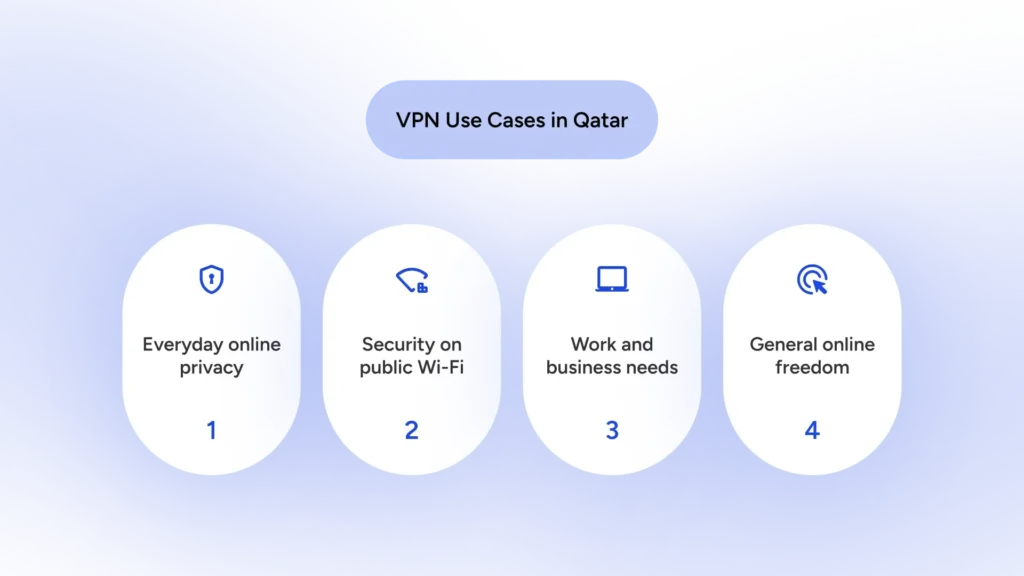
People in Qatar turn to VPNs for practical, everyday reasons, not because they’re trying to break rules, but because they want a smoother, more private, and more reliable online experience. Whether you’re hopping off a plane at Hamad International or living here long-term, a VPN quietly solves several common frustrations in a country with active internet filtering.
Why Travelers Use VPNs in Qatar
As a visitor, you’re often on the go and relying on public networks:
- Secure Public Wi-Fi: Airports, hotels, malls, and cafés have free Wi-Fi, but it’s not always private. A VPN encrypts your connection so hackers or snoopers can’t easily steal your data while you’re checking bank apps or emails.
- Access Home Content: Streaming services from your home country often get geo-blocked. A VPN lets you connect to a server back home and enjoy your usual shows without hassle.
- Reliable Calls Home: Some VoIP services (WhatsApp calls, FaceTime) can be flaky or throttled. A good VPN helps keep those important family conversations clear.
- Privacy & Peace of Mind: Browse sensitive topics, compare flight prices, or handle travel bookings without your activity being tracked by local ISPs.
Nothing kills the post-flight vibe faster than realizing your comfort show is blocked while you’re still jet-lagged in Doha. A VPN fixes that faster than another cup of karak tea.
Why Qatari Citizens and Residents Use VPNs
Locals and expats living in Qatar use VPNs for slightly different but equally valid reasons:
- Everyday Privacy: Protect personal browsing habits from ISP logging, especially on shared or work-related networks.
- Work and Business Needs: Many professionals use VPNs for secure access to company files, protecting sensitive work data when working from home or while traveling within the country.
- Family Communication: Stay reliably connected with relatives abroad through voice and video calls.
- General Online Freedom: Enjoy a broader, uncensored web experience for entertainment, shopping, or education without compromising respect for local laws.
Shared Benefits for Everyone
VPNs aren’t about rebellion; they’re about practicality and protection in a modern Gulf nation that values both security and tradition. Next, we’ll talk about the activities you should definitely steer clear of to keep things fully legal and stress-free.
No matter your status in Qatar, VPNs help with price comparisons for hotels and bookings (sometimes cheaper from other countries), safe online banking while traveling, and simply feeling more in control of your digital life in a highly connected but filtered environment.
Why Qatar Censors the Internet (and How VPNs Fit In)
Qatar censors parts of the internet to protect its cultural, religious, and social values while maintaining a modern, high-speed digital infrastructure.
As a conservative Islamic country, the government (through the CRA) applies filters to block content it considers harmful to public morality, family values, national security, or social harmony. This isn’t about stopping all outside influence but about drawing clear boundaries.
Common Types of Blocked Content
The following list shows the prohibited online content and activities, and it’s best to avoid them while in Qatar, even if you’re using a VPN.
- Adult content and pornography — Strictly filtered.
- Gambling and betting sites — Completely blocked.
- Dating apps and certain social platforms — Many are restricted or limited.
- VoIP services — Features like WhatsApp voice/video calls, or FaceTime, can be unreliable or partially blocked at times.
- Politically sensitive or “immoral” material — Sites criticizing the government, promoting extremism, or conflicting with Islamic teachings.
- Alcohol promotion, drugs, and other prohibited topics.
How VPNs Fit Into This Picture
This is where VPNs become genuinely useful without being rebellious. A good VPN lets you:
- Access legal international content that isn’t blocked for moral reasons but is geo-restricted.
- Secure your connection on public Wi-Fi without exposing your data.
- Maintain privacy for everyday browsing.
Can You Get Caught for Using a VPN in Qatar?
No, or at least, it’s very unlikely to get caught for using a VPN in Qatar, especially if you stick to lawful activities like secure browsing, streaming legal content, or protecting your data on public Wi-Fi. Qatar’s authorities focus on serious violations rather than ordinary citizens or short-term travelers quietly using a VPN.
How Detection Works in Qatar
ISPs (Ooredoo and Vodafone) can technically detect encrypted VPN traffic. However, enforcement is not aimed at casual users. The CRA and cybercrime units prioritize bigger issues like fraud, hacking, sharing illegal content, or activities that threaten public order.
What Happens If You Cross the Line?
Penalties are tied to the underlying offense, not the VPN itself:
- Minor violations (e.g., accessing blocked adult content) can result in warnings or fines.
- Serious breaches under the Cybercrime Prevention Law, such as distributing non-consensual photos/videos, fraud, or spreading harmful false information, can lead to fines up to QR 500,000 and imprisonment ranging from months to years.
- The 2025 amendments strengthened rules around privacy violations, so sharing unauthorized images is one of the more actively enforced areas.
Practical Ways to Minimize Any Risk
- Choose a reputable, no-logs VPN with strong obfuscation.
- Avoid the “definitely avoid” activities listed in the previous section.
- Use the kill switch and don’t leave your VPN on 24/7 if you don’t need it.
- For travelers: Download and test before arrival.
- For citizens/residents: Be extra mindful with work devices or shared networks.
Is It Safe to Use a VPN in Qatar?
Yes, it is generally safe to use a VPN in Qatar, especially when you choose a reputable provider and stick to lawful activities. For both citizens/residents and travelers, a quality VPN actually increases your online safety in several Qatar-specific ways.
Qatar-Specific Safety Benefits
- Public Wi-Fi Protection: Doha’s airports, hotels, malls, and cafés offer convenient free Wi-Fi, but these networks can be targeted by cybercriminals. A VPN encrypts your connection, protecting sensitive actions like online banking, email, or booking excursions.
- Privacy from ISP Tracking: Local providers (Ooredoo and Vodafone) can see your activity on unencrypted connections. A no-logs VPN keeps your browsing private.
- Secure Business and Daily Use: Many companies in Qatar require or recommend VPNs for remote work and data protection. This shows official acceptance of secure tools.
The Honest Risks in Qatar
Safety isn’t absolute. The main risks come from how you use the VPN, not the tool itself:
- Using it to access clearly prohibited content (pornography, gambling, etc.) can trigger issues under the Cybercrime Law, as ISPs may detect VPN traffic and enforcement focuses on violations.
- Poor-quality or free VPNs make money by logging your data and selling it to data brokers.
- In rare cases, advanced detection exists, but everyday responsible users (citizens checking international news or travelers streaming home content) face a very low risk of problems.
For more general advice on choosing secure VPN features (like kill switches, encryption standards, and leak protection), check out our dedicated article on VPN safety.
Conclusion
Using a VPN is completely legal for both citizens and travelers, as long as you stick to lawful activities and respect Qatar’s cultural and legal boundaries. The technology itself is not banned, and it can be a smart, practical tool for privacy, secure browsing, and staying connected in a country with thoughtful internet filtering.
FAQs
Yes, using a VPN is completely legal in Qatar for both citizens and travelers.
Yes, tourists can safely use a VPN in Qatar.
It depends on the website. Using a VPN to access clearly prohibited content (pornography, gambling, or material violating public morality) can breach Qatar’s Cybercrime Law. Accessing legal international content like your home Netflix library is generally fine.
Qatar’s Cybercrime Prevention Law (Law No. 14 of 2014 and 2025 amendments) does not mention or ban VPNs. It focuses on crimes like hacking, fraud, and sharing content that violates privacy or public values.
Yes, using a VPN actually increases safety on public Wi-Fi at airports, hotels, and malls. For everyday lawful use, risks are very low for short-term visitors.
It’s not recommended. Free VPNs often have weak security, data logging, and slow speeds.
Using a VPN to make WhatsApp or other VoIP calls is generally acceptable for personal use. However, some VoIP features can still be unreliable due to local filtering, even with a VPN.
Yes, it’s highly recommended. Some VPN provider websites may be blocked after you land, making it harder to download and set up upon arrival.
Look for strong obfuscation/stealth servers, no-logs policy with audits, fast nearby servers, a kill switch, and good streaming performance. Test with a money-back guarantee.
No, you don’t need to worry about using a VPN in Qatar as it is completely legal, but you need to be careful about how you use it.
Article by
-
 Sam Clarke
Sam is a cybersecurity and online privacy writer dedicated to making complex network protection accessible, practical, and engaging.





Share your thoughts
Add a comment